


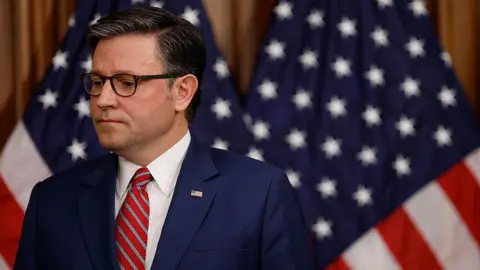
 Photo Agency
A spending plan that would terminate the most extended government shutdown in American history is advancing toward the House of Representatives for a critical decision on midweek.
On day 43 of the political impasse, representatives are returning to Washington to vote on whether to endorse a Senate package that would finance government departments for 60 days.
GOP leaders stated assurance the spending plan would be approved by the lower chamber, despite their slim advantage. But Democratic leadership pledged to fight it.
"We're restoring our United States," he announced on yesterday at a Veterans Day event in the Virginia suburb. "Shouldn't have been halted."
Consequences of the Funding Lapse
The shutdown, which started on October 1st, has left a million federal workers without pay, stopped nutrition assistance for low-income Americans, and disrupted aviation for flyers ahead of the November celebration.
With approximately 1,200 departures grounded on Tuesday as government employees without pay call in sick because of the funding deadlock, legislators are seeking alternative methods to reach Washington.
- Representative Crawford of his home state announced online that he was traveling together with a party member, the Mississippi congressman of the Magnolia State, to the federal district.
- The Wisconsin lawmaker stated he would be traveling on a motorcycle from his district of the Midwest state.
"It will be a somewhat brisk," he wrote on social media of the extended journey. "But I will perform my responsibilities."
Congressional Procedure
The legislative panel moved the legislation forward in a partisan procedural decision by eight to four in the early hours of the crucial date, concluding a extended meeting.
Majority party representatives dismissed opposition proposals aiming to continue terminating medical coverage assistance - their main demand during the impasse.
The chamber is expected to reconvene at the afternoon session (evening universal time) to conduct sixty minutes of discussion on the proposal before a vote.
Minority Position
Opposition chief the New York representative of his constituency promised to challenge the bill.
"We firmly object as the minority party to this reckless Republican effort to keep elevating the expensive lifestyle on everyday Americans," he told the media outlet.
The Democratic leader has shown irritation with Democratic senators who aligned with GOP members on the previous evening to approve the budget proposal.
Major Points
A central demand of Democrats during the funding gap has been that GOP lawmakers add to the budget legislation a clause to continue government subsidies that make medical coverage less expensive for millions of citizens.
But the majority party maintained solidarity and would not move, agreeing only to allow a ballot next month on the healthcare subsidies, something they had offered weeks ago.
And there is doubt that measure will be approved by the Senate, while House Speaker Mike Johnson has still not guaranteed a ballot for the fiscal incentives in his legislative body.
Political Dynamics
The Speaker has kept the House out of session for nearly two months to increase leverage against Senate Democrats to settle the impasse.
Ahead of the decisive decision he will swear in Arizona congresswoman-elect the newly elected official, a Democrat who was elected in a by-election in September.
Once she has taken the official pledge, the majority party margin in the House will be reduced to a five-vote margin – 219-214.
That indicates Johnson can must limit defections to two Republicans on each partisan ballot.
Economic Considerations
The budget places the US government on track to continue accumulating about $1.8 trillion (1.4 trillion pounds) a year to its massive existing in government obligations.
But the Texas representative of the Lone Star State said he was "unaware of any opposition of consequence" to the proposal from spending watchdogs in his right-wing faction.
Potential Republican defectors the Kentucky representative of Kentucky or Victoria Spartz of the Hoosier State have remained tight-lipped so far on how they plan to vote.
But even if they do defect from the party, the presiding officer could possibly secure approval with the help of centrist opposition members, such as Jared Golden of the Pine Tree State or the conservative-leaning representative of Texas.
Electoral Consequences
Neither party looks to have survived without damage from this legislative imbroglio.
Opinion polls show voters believe Republicans bear somewhat greater of the culpability, while Democrats were deeply fractured by the political maneuvering.
And once the shutdown is over, appropriators have just two months to avert the subsequent closure.
Federal appropriations would next be due to expire on January 30th.



