
Surgeons from the Scottish region and the US Accomplish World-First Brain Operation Via Robotic System
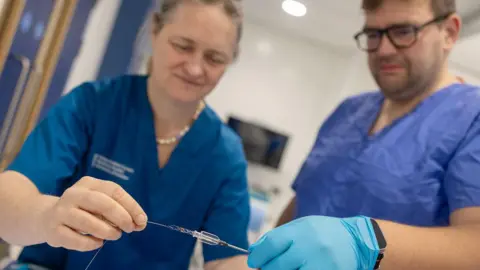
Surgeons from Scotland and America have accomplished what is believed to be a pioneering stroke surgery utilizing robotic technology.
The medical expert, associated with a Scottish university, conducted the remote thrombectomy - the removal of blood clots after a cerebral event - on a medical specimen that had been provided for research.
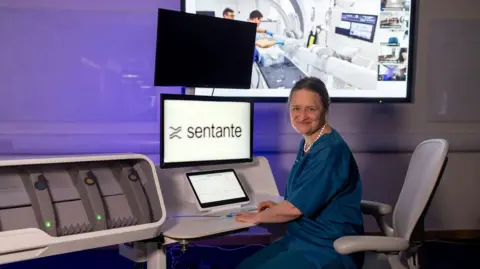
The expert was positioned in a treatment center in the location, while the specimen being treated with the machine was across the city at the university.
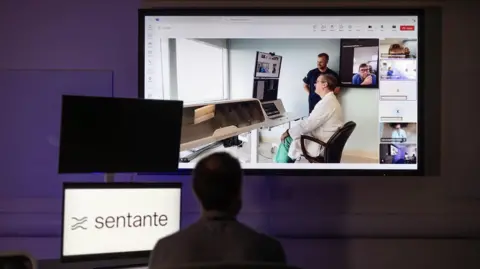
Later that day, Ricardo Hanel from the US location used the equipment to carry out the pioneering long-distance operation from his Jacksonville base on a donated cadaver in the Scottish city over 6,400km away.
The research collective has labeled it a potential "game changer" if it receives authorization for clinical application.
The doctors believe this innovation could transform cerebral healthcare, as a limited availability of professional intervention can have a major influence on the chances of recovery.
"It seemed like we were seeing the early preview of the next generation," said the lead researcher.
"Whereas before this was considered theoretical concept, we showed that all stages of the operation can now be performed."
The Scottish institution is the international education hub of the global medical association, and is the sole location in the Britain where medical professionals can work with medical specimens with biological fluid pumped through the vessels to simulate procedures on a living person.
"This was the first time that we could perform the whole mechanical thrombectomy procedure in a real human body to demonstrate that every phase of the surgery are feasible," stated the lead expert.
A healthcare leader, the director of a stroke charity, described the transatlantic procedure as "a significant breakthrough".
"During many years, residents of countryside locations have been deprived of access to clot removal," she stated.
"Such technological systems could address the disparity which exists in medical intervention nationwide."
How does the technology work?
An blockage stroke occurs when an vascular pathway is clogged by a obstruction.
This interrupts circulation and oxygenation to the cerebral tissue, and neurons stop functioning and die.
The optimal therapy is a surgical extraction, where a expert uses catheters and wires to extract the blockage.
But what transpires when a patient can't get to a expert who can perform the surgery?
The medical expert stated the study proved a automated system could be linked with the equivalent surgical tools a surgeon would normally use, and a medical staff who is attending the case could easily connect the tools.
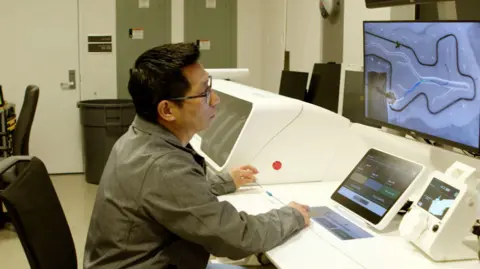
The expert, in a separate site, could then operate and direct their own wires, and the automated system then performs precisely identical actions in immediate sequence on the individual to carry out the clot removal.
The individual would be in a hospital operating room, while the specialist could perform the operation with the automated equipment from any location - even their private dwelling.
The lead researcher and Ricardo Hanel could observe real-time imaging of the specimen in the experiments, and track developments in immediate feedback, with the Scottish specialist saying it took only 20 minutes of preparation.
Tech giants prominent manufacturers were involved in the research to ensure the connectivity of the automated system.
"To perform surgery from the US to the Scottish nation with a minimal delay - an instant - is truly remarkable," commented the neurosurgeon.
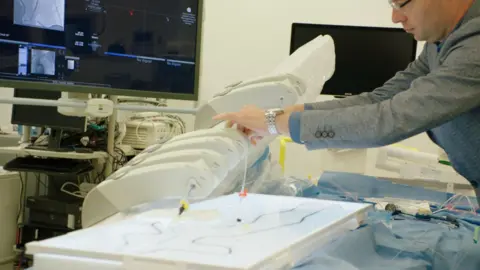
Innovations in cerebral healthcare
The medical expert, who has received recognition for her work and is also the executive member of the World Federation for Interventional Stroke Treatment, said there were primary challenges with a traditional procedure - a worldwide deficiency of doctors who can do it, and care is determined by your location.
In the Scottish nation, there are only three places people can receive the procedure - Dundee, Glasgow and Edinburgh. If you reside elsewhere, you must commute.
"The procedure is very time sensitive," said the medical expert.
"Each six-minute postponement, you have a 1% less chance of having a positive result.
"This innovation would now deliver a novel approach where you're not reliant upon where you reside - saving the crucial moments where your neural tissue is deteriorating."
Public health data revealed there were {9,625 ischaemic strokes|numerous cerebral events|

